
Soil & water studies
ICERD Cameroon
Soil (parcel F) and water analysis. Author of the 2026 field-visit report and environmental expert of the project's ESG & Compliance Committee.

Ecosystem
A mature ecosystem of technical, financial and institutional partners serving the PROAQUI project — from the first-rank integrator to the supervising authorities.
First-rank technical and financial partner
The PROAQUI project is carried by ZEIAQUA-INDUSTRIE SA, a project company subsidiary of ZEIDEAL GROUP SAS, in a first-rank technical and financial partnership with TACE Trading. Beyond a mere supplier, TACE Trading is the integrator of the agro-industrial complex: it provides the overall technical structuring and the ongoing support of the project company's Management Committee.
Institutional framework
PROAQUI is a structuring private project embedded in the "Plaine Centrale" programme led by the State of Cameroon — a land-development and large-farmer-settlement programme along the Batchenga–Ntui–Yoko–Tibati–Ngaoundéré corridor, led by MINADER and MINDCAF within the import-substitution policy of the 2020–2030 National Development Strategy. ZEIDEAL GROUP SAS formalized its inclusion in this framework by signing a Memorandum of Understanding (MOU) with the State of Cameroon, attesting institutional recognition of the project and the award of the Dir land concession.
Engineering & advisory firms
PROAQUI's technical, environmental and regulatory maturity is attested by executed and contracted assignments, fully self-financed by ZEIDEAL GROUP SAS.
Soil & water studies
Soil (parcel F) and water analysis. Author of the 2026 field-visit report and environmental expert of the project's ESG & Compliance Committee.
Agronomic & hydric characterization
Hydric, cartographic, geodesic, hydrological and photogrammetric characterization; surveying and agricultural parcelling of Block F.
Environmental & social impact
Detailed Environmental and Social Impact Assessment (ESIA), whose Terms of Reference were approved by MINEPDED.
Mapping & field studies
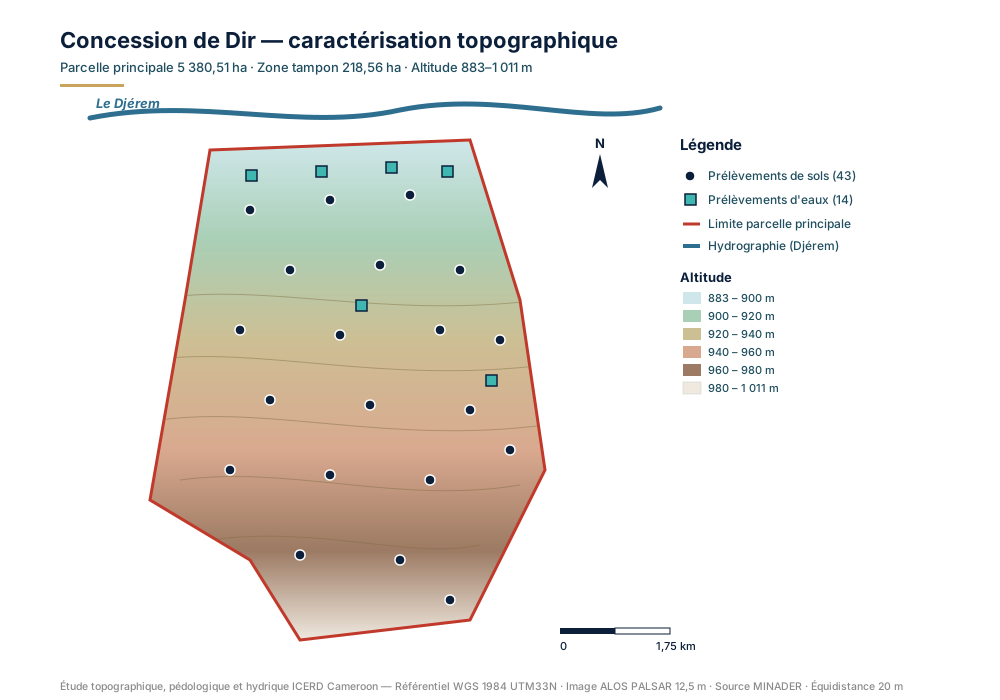
The field assignments produced the full topographic survey of the concession (5,380.51-hectare main parcel and 218.56-hectare buffer zone along the Djérem), the pedological and hydric characterization (43 soil and 14 georeferenced water sampling points) and the 31-year climate analysis. WGS 1984 UTM33N reference, ALOS PALSAR 12.5 m imagery, MINADER-sourced data.
International technical partners
PROAQUI relies on the world-reference equipment suppliers and operators in industrial aquaculture and animal nutrition.
Norway · Global equipment supplier
Supplier of tropical floating aquaculture cages (417 cages at full capacity). World leader in cage aquaculture systems.
Brazil · Extrusion technology
Supplier of the extruded-pellet feed plant (100,000 tpa: 76 kt fish + 24 kt related), world leader in multi-species extrusion-granulation technology.
United Kingdom · Complementary equipment
Supplier of complementary aquaculture equipment: nets, anchoring, instrumentation and connected biometrics.
Indonesia · Technical reference
World technical reference in tropical tilapia aquaculture (Indonesia, Honduras, Mexico), the project's benchmark farming standard.
Interprofessional & local partners
Aquaculture interprofession
Interprofessional Organization for the Development of Aquaculture in Cameroon — agreement for the promotion and distribution of fish feed, fingerlings and aquaculture equipment.
Operating partner — Nyong-Mfou
Mfou District Development Committee — operational partner of the Mfou hatchery (owned 100% by the project company) serving the Nyong-Mfou aquaculture pole.
Engineering & assembly
Cameroonian technical partner in tropical aquaculture engineering and project assembly support.
Accounting & financial expertise
Accounting and financial advisory firm, contributing to the consolidated financial model and the pilot-phase accounting.
Reservoir operator
Electricity Development Corporation — operator of the Mbakaou hydroelectric dam, party to the aquaculture water-use agreement.
Financial architecture
PROAQUI financing mobilizes a two-tier lender ecosystem: a Phase 1 pilot round (national and bilateral lenders), then an international structuring architecture arranged by Afreximbank as sole Mandated Lead Arranger from Phase 2 onward. Tranche details are on the Investors page.
| Financial partner | Role |
|---|---|
| Afreximbank | Sole Mandated Lead Arranger (Phase 2) — OECD ECA syndication, Local Costs line, project preparation facility |
| PIISAAH BC-PME | Lead lender of the Phase 1 pilot |
| Banco do Brasil — PROEX | Buyer's credit for imported Brazilian equipment |
| Republic of Cameroon (C2D + BIP) | Sovereign tranche (Phase 2), within the Plaine Centrale programme |
| AfDB + BDEAC | Multilateral DFIs (Phase 2) — AfDB is the reference lender of the Plaine Centrale programme |
| Proparco/AFD + UNCDF | Bilateral DFIs (Phase 2) |
| UKEF + EKSFIN + PROEX | Syndicated OECD export-credit agencies (Phase 2) |
Supervising authorities
The project is conducted in relation with the competent Cameroonian authorities, in compliance with sectoral, environmental and land regulations.
Becoming a satellite operator
PROAQUI's 70/30 orchestrator model reserves 30% of output for satellite operators: autonomous companies, cooperatives and common-interest groups (GICs) specialised either in aquaculture or in farming. The project company runs 70% of capacity in-house and entrusts the remaining 30% to satellites. At full capacity, the aquaculture component comprises 160 satellite cages (74 at Mbakaou, 86 at Nyong-Mfou). The approach is deliberately inclusive: the number of partners is not capped, serving as many technically and economically viable operators as possible.
Who can become a satellite?
PROAQUI's interventions
The role of satellites
Satellites are autonomous enterprises that operate their own production units and bear the related investment. PROAQUI cedes them neither its land nor any pre-financing. The contracts clearly specify PROAQUI's interventions for each satellite — technical support, input supply and a guaranteed outlet. Satellites thus focus on their production, strengthening local inclusion and the complex's scale-up.
The three types of satellite
Beyond the satellites, the plant sources from suppliers of raw materials for its by-product feeds (poultry, cattle and pig feed). These suppliers are not part of the satellite model: they receive neither TACE Trading's technical support nor the skills transfer reserved for satellites. This is a standard commercial supply relationship.
Register your interest: our team will get back to you to assess your project and walk you through the onboarding path.
Structuring the sector
To structure the aquaculture satellite segment over the long term, the Group supports the future creation of the Cooperative of Cameroon's Aquaculturists (CODAC), a technical organ of CODAM (the Mfou District Development Committee). CODAC will be tasked with federating Cameroon's aquaculturists, promoting aquaculture as a sector of the future, and forming the privileged antechamber from which the satellite aquaculture operators will be drawn — operators who will apply to join the PROAQUI project and operate the 30% of output reserved for this segment.
CODAC will thus form the organised pool from which PROAQUI identifies, trains and selects its future satellite aquaculture partners, ensuring consistent technical standards and strong local roots.