
PROAQUI agro-industrial and aquaculture complex

The industrial project

PROAQUI — Cameroon's integrated agro-industrial and aquaculture complex

Integrated agro-industrial and aquaculture complex · 70/30 value-chain orchestrator model · 45,090 tonnes of fish per year at full capacity · Part of the State of Cameroon's "Plaine Centrale" programme.

Home · The PROAQUI Project

First-rank technical and financial partner

PROAQUI is structured in partnership with TACE Trading

The PROAQUI project is carried by ZEIAQUA-INDUSTRIE SA, a project company subsidiary of ZEIDEAL GROUP SAS, in a first-rank technical and financial partnership with TACE Trading. As integrator, TACE Trading provides the technical structuring of the agro-industrial complex, the integration of international equipment suppliers, liaison with international lenders, and the ongoing support of the project company's Management Committee.

Explore the partner ecosystem

Presentation video

The PROAQUI Mega-Project in 6 minutes


An educational presentation of the PROAQUI project: from the CEMAC fish deficit to the vertical integration strategy, through the 70/30 orchestrator model and the three industrial poles and the financing plan. Animated video format, a complement to the investor brochure. Note: video currently in French — English version planned.

Duration: 8 min 47 s HD Quality: 720p FR Language: French Download (18 MB)

Industrial architecture

A 100% controlled value chain


PROAQUI applies a matrix-based vertical integration model unprecedented in Central Africa. Rather than a sequential chain in which each link depends on the previous one within a single flow, the project rests on three parallel operational loops.

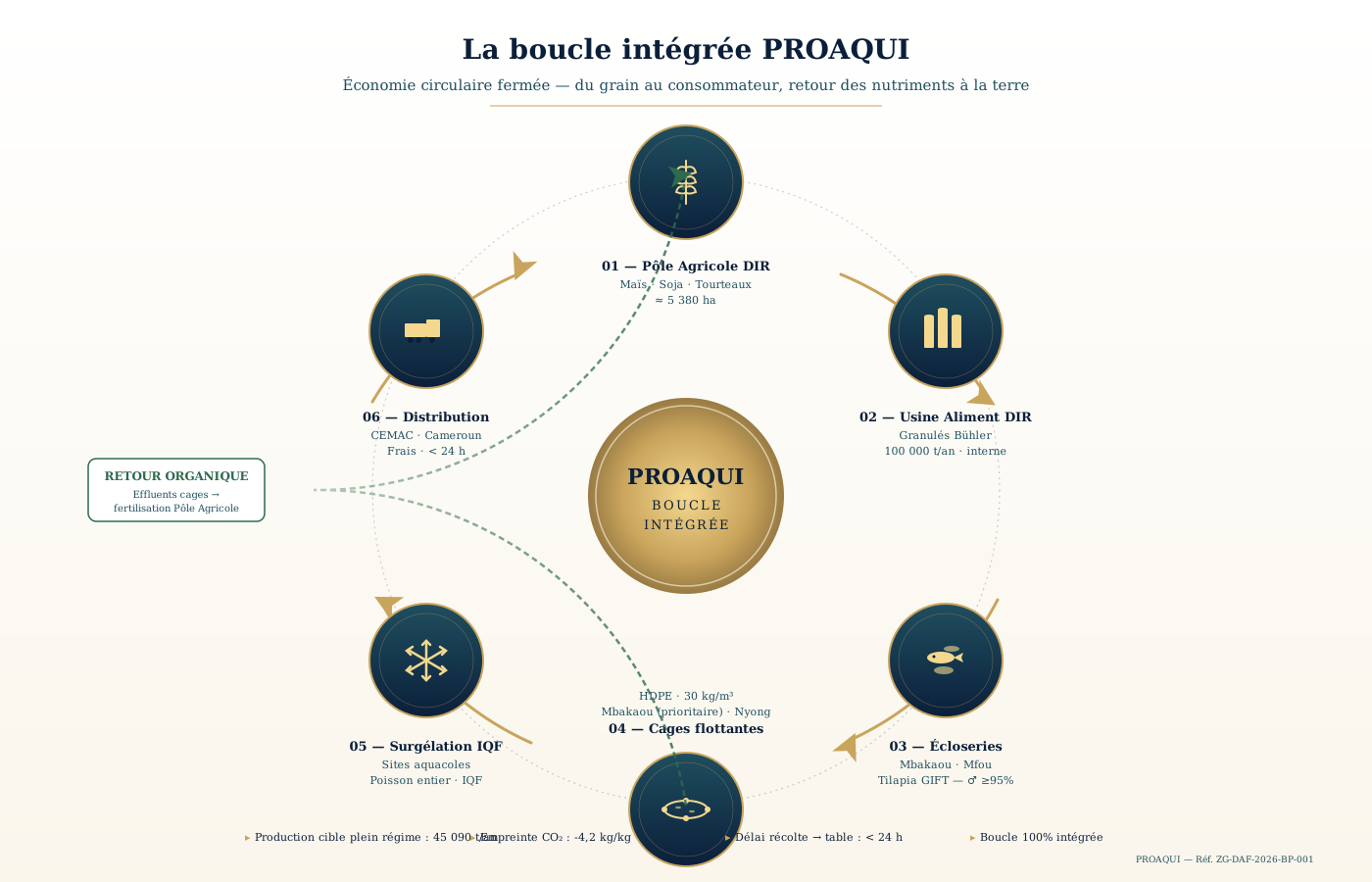
PROAQUI integrated short-circuit diagram
PROAQUI short circuit: 6 coordinated stages from farming to distribution, with virtuous loop of effluent valorisation.
01DIR Agricultural Hub5,380 ha — maize, soy, rice bran
02DIR Feed PlantBühler do Brasil — 100,000 tpa
03Internal hatcheriesOn aquaculture sites — Mbakaou + Mfou (100% SPV)
04Floating cages417 AKVA Group cages (full capacity)
05IQF freezingOn aquaculture sites — no processing
06CEMAC distributionDIR logistics platform

This three-parallel-loop architecture eliminates unrealistic logistical flows — such as transporting fresh fish over 600 kilometers between aquaculture sites and a centralized processing facility. It guarantees full operational resilience: any localized incident on one of the three poles does not paralyze the others. By design, this is a Business Continuity Plan superior to any centralized architecture.

Species and genetics

Selected species: Oreochromis niloticus, GIFT strain


PROAQUI selected the Nile tilapia (Oreochromis niloticus), GIFT strain — the ninth generation of the Genetically Improved Farmed Tilapia program led since 1988 by WorldFish-ICLARM in Malaysia. It is the most thoroughly documented strain in the world, used by industry-leading operators: Regal Springs in Indonesia, Lake Harvest in Zimbabwe, Yalelo in Zambia.

The vertical coherence of the project requires that internal hatcheries (Mbakaou + Nyong/Mfou) produce exclusively the same GIFT strain as the one farmed in the cages, guaranteeing zero external dependency for fingerlings.

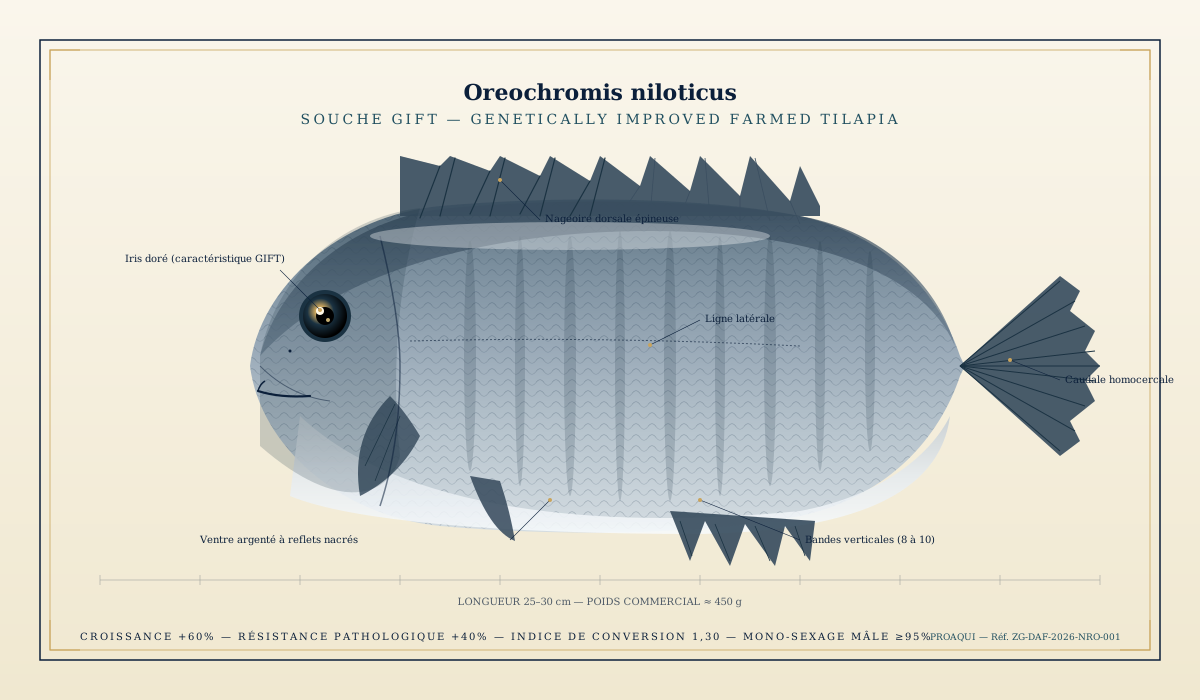
Tilapia Oreochromis niloticus GIFT strain
Oreochromis niloticus GIFT strain — WorldFish-ICLARM program, male monosex ≥ 95%.
SpeciesOreochromis niloticus (Nile tilapia)
StrainGIFT (Genetically Improved Farmed Tilapia, WorldFish)
Genetic sourceWorldFish-ICLARM (Malaysia), program initiated in 1988
Sex ratioAll-male monosex ≥ 95% via approved 17α-methyltestosterone protocol
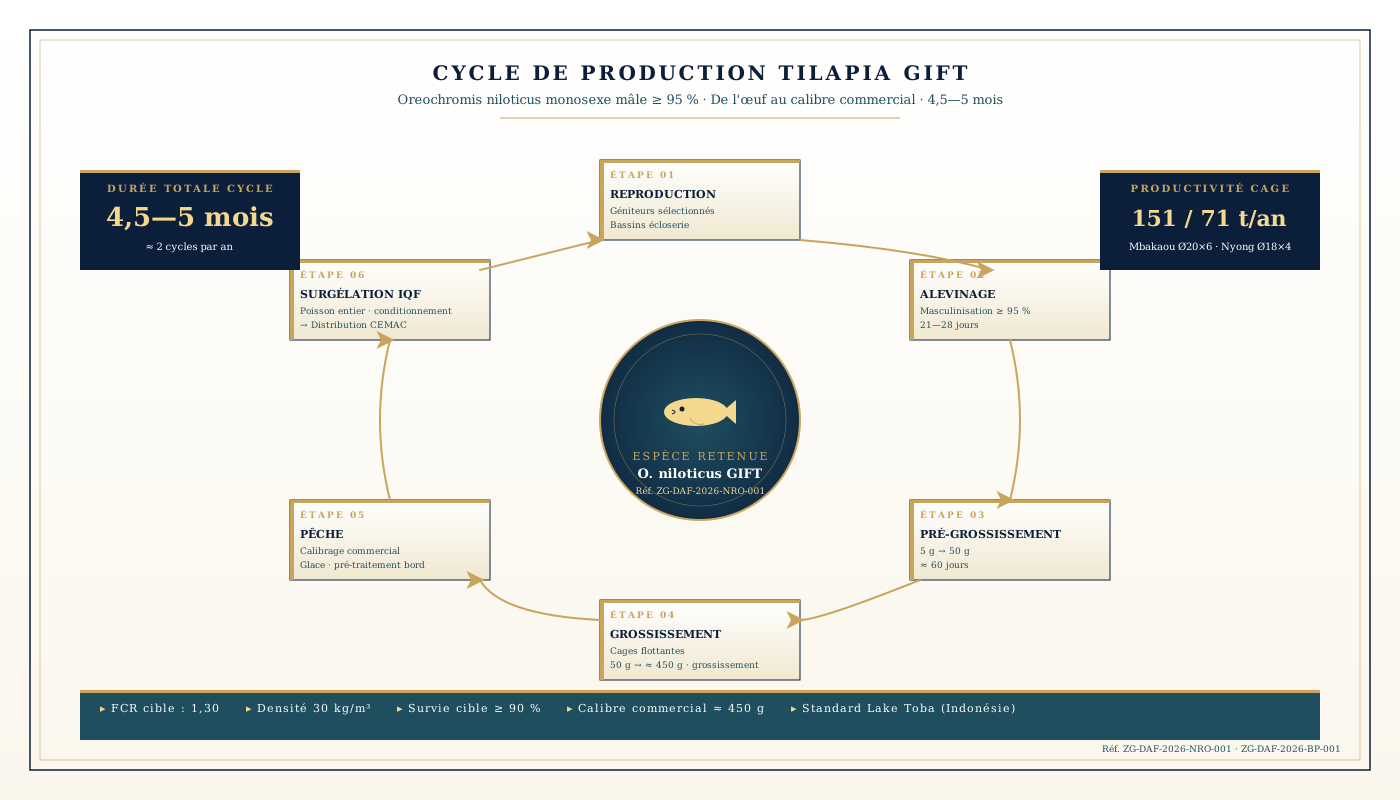
Production cycle4.5 to 5 months (≈ 2 cycles/year), from fingerling to ≈ 450 g commercial fish
Target FCR1.30 from Phase 1 (premium imported feed)
Internal hatcheriesMbakaou ≈ 90M fingerlings/year + Mfou ≈ 49M fingerlings/year
Cage equipmentAKVA Group — Ø 20 m × 6 m (Mbakaou) / Ø 18 m × 4 m (Nyong) — Regal Springs technical reference
Tilapia GIFT biological production cycle - from egg to commercial size

Industrial trajectory

A controlled ramp-up across four phases


PROAQUI rolls out along a progressive four-phase industrial trajectory over a ten-year horizon. Phase 1 is a pilot whose financing need, set bottom-up, stands at ≈ FCFA 17.3 billion, designed to prove the model's viability across both aquaculture sites before the structuring rollout. Phase 2, the major industrial turning point, mobilizes an international round arranged by Afreximbank as sole Mandated Lead Arranger (need of about FCFA 15.9 billion) and marks the commissioning of the DIR Industrial Pole. Phases 3 and 4 raise production to 45,090 tonnes per year at full capacity by Year 10.

Phase 0 · Preparatory phase (2023 → mid-2027) — ongoing

Studies, maturation and financial structuring. Under way since 2023 and still ongoing, Phase 0 is fully self-funded by ZEIDEAL GROUP SAS through in-kind contributions. It covers the studies, project maturation and structuring, and concludes at the Phase 1 financial close (mid-2027). It precedes the production ramp-up described below.

PhasePeriodMarkerMarketed productionNet CAPEX deployedMilestone
Phase 0 — Maturation2023 → mid-2027Self-funded (in-kind contributions)Studies, engineering, structuring; financial close mid-2027
P1 Construction2027Year 008,726 MCommissioning Q3 2027
Phase 1 — Pilot (Nyong)Q3 2027 → Q3 2029Year 1–2~5,000 tpa (5,049)— (committed in 2027)First sales 2028
Phase 2 — Mbakaou + feed plant (DIR)Q3 2029 → Q3 2031Year 3–4~15,000 tpa14,116 M (deployed 2029)Feed plant commissioning
Phase 3 — ExtensionsQ3 2031 → Q3 2033Year 5–6~28,000 tpa18,442 M (deployed 2031)Ramp-up of both sites
Phase 4 — Full capacityQ3 2033 → Q3 2035Year 7–8~45,000 tpa (45,090)18,044 M (deployed 2033)Full capacity reached
Steady stateQ3 2035 → Q3 2037Year 9–10~45,000 tpaFull capacity maintained

At full capacity (Year 10), the project targets consolidated revenue of FCFA 110 billion, an operating EBITDA of FCFA 28.6 billion (26.2% margin) and a Weighted Average Cost of Capital of 7.8%. It delivers a net present value of FCFA 77.7 billion, an internal rate of return of 23.9% (37.0% on equity) and a minimum DSCR of 2.23x. PROAQUI's output would represent about 8% of CEMAC fish demand (estimated at 600,000 tonnes per year), confirming the relevance of an import-substitution strategy.

Territorial architecture

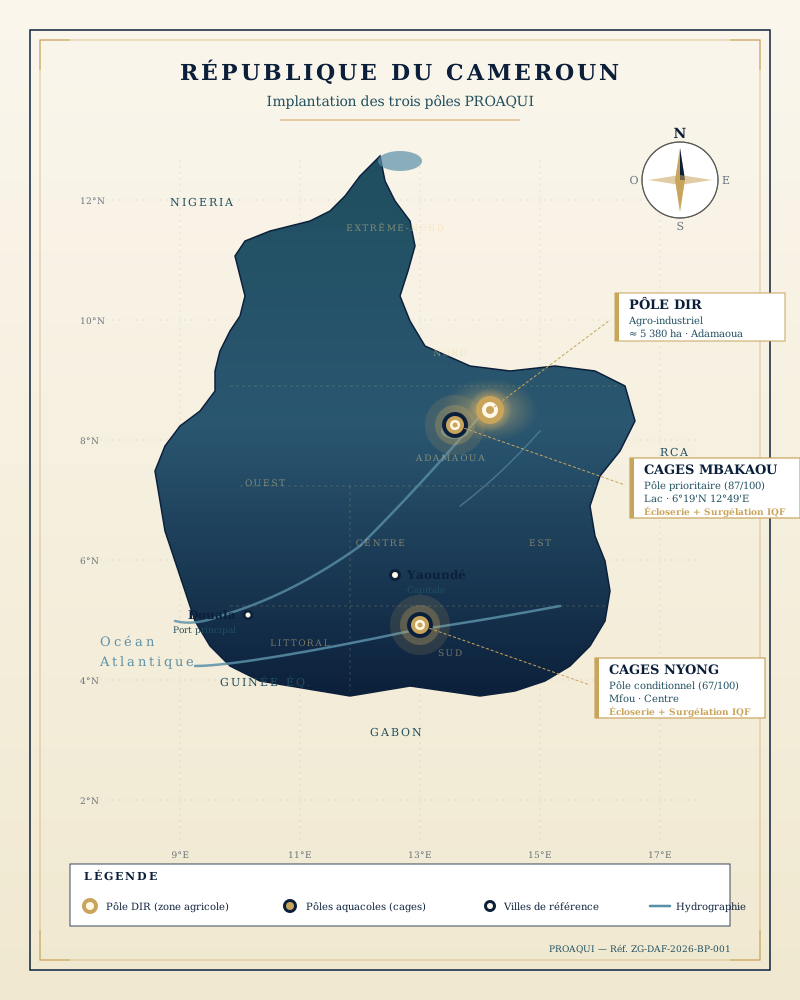
Three sites, three roles


Map of Cameroon with PROAQUI three poles location
Geographic location of the three PROAQUI poles on Cameroonian territory.
Agricultural hub
DIR · Adamaoua

DIR Agro-Industrial Hub

5,380 hectares granted by the Republic of Cameroon under the "Plaine Centrale" programme. Large-scale irrigated industrial farming (maize, soy, rice bran, oilcake). Bühler do Brasil feed plant, 100,000 tpa (76 kt fish + 24 kt related), multi-species. Living base, silos and CEMAC distribution platform.

Aquaculture site
Mbakaou · Adamaoua

Mbakaou Aquaculture Pole

Mbakaou dam reservoir (operated by EDC). ≈ 246 AKVA Group floating cages at full capacity (172 direct + 74 satellite) for ≈ 29,300 tpa. Hatchery owned and operated 100% by the project company (≈ 90M fingerlings/year). On-site IQF freezing and negative storage, no processing. EDC agreement under negotiation.

Aquaculture site
Nyong · Centre / East

Nyong-Mfou Aquaculture Pole

Akonolinga–Olama river sections. ≈ 287 AKVA Group floating cages at full capacity (201 direct + 86 satellite) for ≈ 15,800 tpa. Mfou hatchery owned and operated 100% by the project company, with CODAM as local operating partner (no ownership or management) — ≈ 49M fingerlings/year. On-site IQF freezing and negative storage, no processing.

A strict architectural rule

Why the DIR Hub hosts no hatchery, no cages and no processing

The DIR Hub hosts no hatchery, no floating cages, and no aquaculture processing unit. These functions are operated exclusively at the Mbakaou and Nyong aquaculture sites, each of which has its own site-level hatchery and its own IQF freezing unit.

This strict separation is not a constraint but a deliberate design. It guarantees full self-sufficiency of the aquaculture sites in fingerling production — the species produced by the hatcheries are exactly those raised in the adjacent cages. It eliminates long-distance fresh-fish flows, which would have been technically unrealistic and economically unsustainable. It finally preserves the multi-regional territorial anchoring of the project, a precondition for social acceptability and the creation of local jobs.

Going deeper into PROAQUI

Interested in PROAQUI? Explore every dimension of the project.

Download the investor brochure or explore our ESG commitments, our governance, and our financing strategy.